
The classic scenario: you turn the key in the ignition of the Clio 2, the starter engages the engine, but nothing happens. The red warning light stays on the dashboard, and the car refuses to cooperate. Before considering a mechanical failure, it’s often the anti-theft system that blocks the injection. Deactivating this device on a Renault Clio 2 requires a methodical diagnosis, not blind tinkering.
Red warning light on the dashboard: read the signal before intervening
The amount of information provided by the anti-theft warning light is often underestimated. Its behavior changes depending on the state of the system, and confusing it with a simple standby indicator leads to costly diagnostic errors.
A slow blinking light, with the vehicle off, indicates that the protection is normally armed. This is the expected operation. However, a fast blinking light at the moment of contact signals a key recognition failure. The engine control unit receives an incorrect code, or no code at all, and cuts off the injection for safety.
The first reflex to adopt: try the spare key. If the second key starts the car without difficulty, the failure is on the side of the usual key (worn transponder, faulty internal soldering). If both keys are rejected, the problem lies with the vehicle, likely with the UCH or the antenna around the ignition. This test takes thirty seconds and guides the rest of the intervention.
To better understand each step of the procedure, the deactivation of the anti-theft system on the Renault Clio 2 relies on a logical sequence that can be reproduced without a diagnostic tool in certain cases.
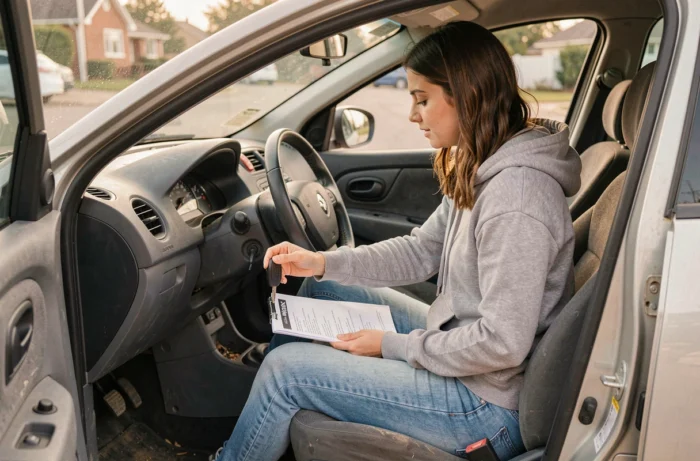
Transponder key and UCH Clio 2: the duo to check first
On the Clio 2, the anti-theft system operates through a dialogue between the transponder chip housed in the key and the body control unit (UCH). The UCH then relays the authorization to the engine control unit. If any link in this chain breaks communication, the engine runs idle.
A technical point that many ignore: the transponder chip does not depend on the remote control’s battery. The central locking function and the starting function are two distinct circuits. A remote control that no longer opens the doors does not mean that the key is unable to deactivate the anti-theft system. Both failures must be addressed separately.
When the UCH no longer communicates
The UCH of the Clio 2 is known for its weaknesses against humidity and aging solder joints. Over time, the micro-soldering on the printed circuit board cracks. The electronic box then loses its ability to read the code transmitted by the key, even if it functions perfectly.
Replacing the UCH without re-pairing it with the control unit and keys leaves the car immobilized. This is a common trap on forums: an used UCH is installed, and the vehicle remains blocked because the codes no longer match. The re-pairing requires the specific PIN code for the vehicle, usually provided on the code card given at purchase.
Deactivate the anti-theft system Clio 2 without a diagnostic tool: method by PIN code
The most accessible method to neutralize a stubborn anti-theft system on Clio 2 is to use the vehicle’s PIN code. This four-digit code allows reprogramming the recognition between the key, UCH, and control unit.
- Find the PIN code on the Renault code card (provided with the new vehicle) or have it extracted by a professional equipped with a compatible diagnostic tool
- Insert the key in the ignition without starting, then follow the code entry sequence via the steering wheel controls or by turning the key depending on the version of the UCH
- Wait for confirmation by the extinction of the red light: the control unit accepts the key again and allows injection
The procedure varies slightly between Clio 2 Phase 1 (before 2001) and Phase 2. On Phase 1, some models have a dedicated decoder socket that accepts a ready-to-use deactivation key programmed with the PIN code. On Phase 2, management is more through the UCH and the manipulation is done at the ignition.
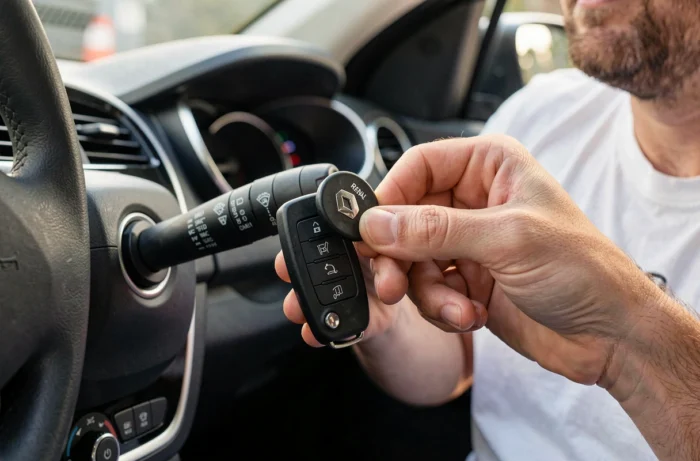
Electronic diagnosis or manual intervention: when to choose
When you have the PIN code and only one faulty key, manual reprogramming is sufficient in most cases. The problem becomes more complicated when the UCH itself is at fault.
An electronic diagnostic check becomes necessary if both keys fail and the red light blinks quickly at contact. The diagnostic tool allows reading the fault codes stored in the UCH and the control unit, identifying whether the failure comes from the ignition antenna, an internal soldering issue in the UCH, or a communication failure between units.
Some preparers offer a reprogramming of the engine control unit in “immo off” mode, which permanently removes the transponder verification. This solution works, but it has consequences that are not always measured at the time of intervention:
- The vehicle becomes startable with any key cut to the correct profile, which removes all electronic anti-theft protection
- The insurer may refuse compensation in case of theft if the modification is noted during the inspection
- Reselling the vehicle poses a technical traceability problem, especially if the technical inspection evolves towards more thorough electronic checks
For a Clio 2 used daily and normally insured, reprogramming the keys via the PIN code remains the most balanced solution. It restores the original operation without compromising the vehicle’s security.
The case of the unique key
Many Clio 2 owners have only one functional key left. If this key starts to show signs of weakness (random starting, need to turn several times), having a second key programmed while the first still works avoids being stuck. Once both keys are out of service, the procedure becomes more complex and must go through a professional equipped.
The anti-theft system of the Clio 2 protects the vehicle, but its components age. Identifying whether the failure comes from the key, the UCH, or the ignition antenna before any manipulation remains the most reliable way to avoid unnecessary part replacement.