Transforming a garden is not just about planting a few flowers and setting up a patio. Every choice of material, plant, or lighting changes the actual use of the outdoor space, its resilience to weather conditions, and its maintenance over several years. Starting from concrete creative ideas helps to structure a coherent landscaping project, adapted to the soil, exposure, and local watering constraints.
Adapting your garden to water scarcity: the first lever of transformation
The most shared garden decor trends on social media rarely show the other side of the coin: a spectacular flower bed can become a watering pit as soon as the first dry summer hits. Before choosing plants or materials, checking local water restrictions can prevent costly disappointments.
An Ifop barometer for Unep, conducted in March 2025, confirms that the French are already changing their practices in response to climate change. Among the cited actions: rainwater harvesting, a less uniform lawn, and the choice of drought-resistant plants.
Prefectural watering restriction orders are not uniform. They vary according to the alert zone and the level of constraint, sometimes even within the same department. The VigiEau website allows you to consult the rules applicable to your exact address. Checking local restrictions before any planting project saves time and money.
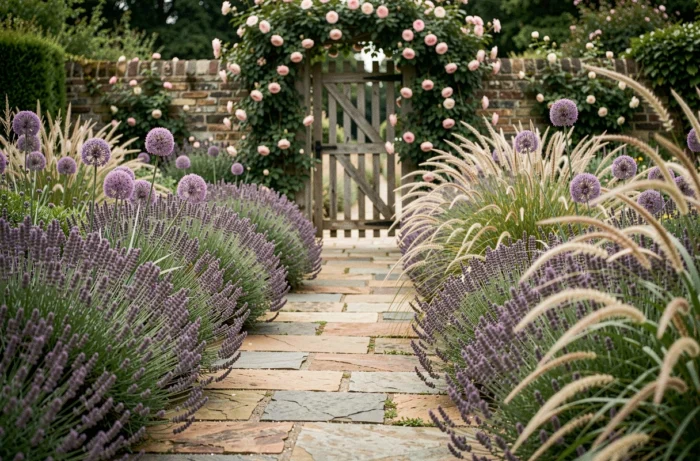
In practical terms, this directs the choice towards water-efficient plants (lavender, ornamental grasses, sedums) and permeable surfaces that allow water to infiltrate rather than run off. With this technical foundation laid, one can explore creative ideas within a realistic framework. A catalog like 100 ideas for the garden helps to identify projects that take these constraints into account while maintaining a genuine aesthetic ambition.
Garden decoration with reclaimed materials: wood and repurposed objects
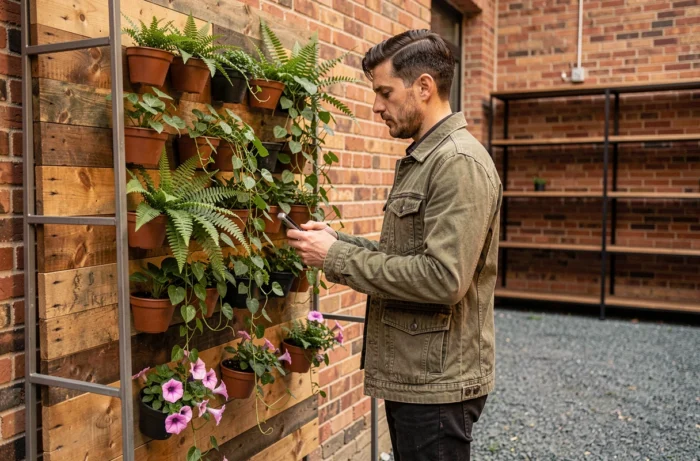
DIY gardening with reclaimed objects is far from an aesthetic compromise. A raw wooden pallet, sanded and treated with linseed oil, becomes a vertical planter capable of hosting herbs or succulents on a fence wall.
Reclaimed wood ages better than plastic in an outdoor context, provided a few rules are followed. Treatment against moisture remains necessary, and woods that have contained chemicals (marked MB pallets, for example) should be avoided for any food-related use or close to edible crops.
Three categories of repurposed objects work particularly well in the garden:
- Metal containers (watering cans, buckets, basins) filled with cascading flowers create focal points without the need for excavation.
- Old window or door frames, fixed against a green wall, add visual depth to a small space.
- Cut tree trunks, used as seating or pot supports, bring a raw touch that integrates into a natural landscaping.
The idea is not to accumulate. Two or three well-placed pieces transform a garden more than a dozen scattered objects without coherence.
Outdoor lighting and biodiversity: balancing ambiance and respect for wildlife
Lighting is among the most sought-after creative ideas for a garden. Solar garlands, recessed lights in a wooden path, lanterns hanging from a pergola: the options are numerous. But poorly designed nighttime lighting disrupts local wildlife, particularly pollinating insects and birds.
The current trend encourages limiting lighting to areas of actual use (patio, access path, entrance) and turning off purely decorative lights after a certain hour. Timers or motion detectors are sufficient to secure a passage without illuminating the garden all night.
For ambiance, candles and flame lanterns remain an alternative that does not produce continuous light pollution. They create a warm atmosphere on a terrace without affecting the garden’s ecosystem.
Choosing between solar and wired
Solar lights are suitable for paths and beds far from a power outlet. Their autonomy depends on the sunlight received during the day, making them less reliable in shaded or north-facing gardens. Low-voltage wired lighting, installed along a path or under a pergola, offers more consistent light but requires a heavier initial setup.
Designing small spaces: terrace, balcony, and urban garden
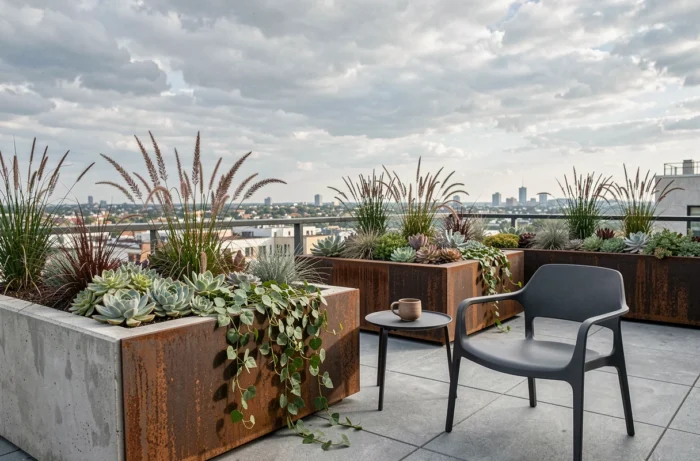
The majority of searches for garden ideas concern modest surfaces. On a terrace of a few square meters, verticality becomes the main lever. Trellises fixed to the wall, tiered shelves, hangings: each gained vertical plane frees up ground space for furniture or circulation.
The 2025 survey by the Société nationale d’horticulture de France (SNHF) highlights that gardeners in raised beds, on balconies or terraces, use less rainwater than those with in-ground gardens. The smaller collection surface partly explains this gap. A simple compact rainwater collector attached to a downspout can nonetheless cover a significant portion of the watering needs of a flowering balcony.
Climbing plants (star jasmine, clematis, honeysuckle) can dress a wall or railing in just a few seasons. They provide greenery, shade, and sometimes fragrance without occupying ground space.
- A pot with a diameter of 40 cm is sufficient for a vigorous climber, provided a stake or taut wire is planned.
- Geotextile planters, lighter than terracotta, are suitable for balconies with limited load capacity.
- Combining a tall plant (grass, non-invasive bamboo) with cascading ground covers creates a mass effect with only two or three containers.
A garden, even reduced to a windowsill, benefits from being thought of as a whole: colors, textures, heights, and watering rhythm. The most sustainable creative ideas are those that start from the constraints of the site (orientation, wind, allowable weight) rather than from an idealized image. It is this project logic, rooted in reality, that makes the difference between ephemeral decoration and a garden layout that lasts over time.