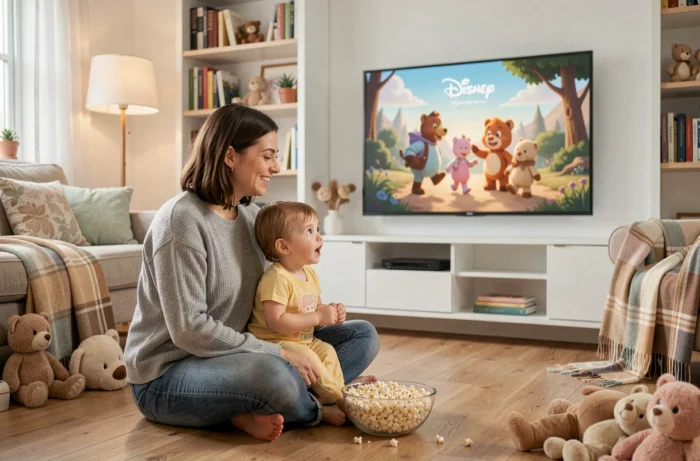
On a a rainy Saturday, the couch is ready, the blanket too, but we hesitate in front of the Disney+ catalog: which movie to start with without risking tears or nightmares at bedtime? Choosing the first Disney movie for a child isn’t just about checking a “suitable for little ones” box on the platform. The child’s temperament, the emotional intensity of the scenes, and the viewing context weigh as much as the age rating.
Why Disney’s age rating is not enough
Disney+ offers youth profiles with classification restrictions and a PIN code. These tools filter out the most inappropriate content, but they do not predict a child’s reaction to a specific scene.
A film rated “all audiences” may contain a parental separation sequence (Bambi, Dumbo) or a visually impressive villain (The Little Mermaid with Ursula). The child’s temperament matters as much as the recommended age. A child sensitive to loud noises will react differently than another fascinated by fantastical creatures.
The American Academy of Pediatrics reminds us that media use depends on the content, the child themselves, and their family environment. This idea is reflected in Bébés Avenue’s parenting tips, which detail a viewing order designed for sensitive little ones.
Before starting a movie, one can watch the trailer alone or go through a scene-by-scene summary. This quick scouting avoids unpleasant surprises without ruining the magic.
First Disney movies for toddlers: focus on gentle pacing
For a child discovering animation, favor films with a slow pace and no threatening antagonist. The goal is not to find the “best” Disney, but the one that matches the child’s emotional tolerance threshold at that specific moment in their development.
What works before preschool
Short films or episode compilations are often more suitable than a feature-length film. A toddler’s attention span does not always cover a full movie, and a break in the middle can break immersion without providing reassurance.
- Winnie the Pooh: no villain, simple dialogues, sequences that work almost independently of each other. The narrative pace is close to that of a storybook read aloud.
- Mickey Mouse Clubhouse (series format): short episodes that encourage child participation, with a reassuring repetitive structure.
- Dumbo (classic version): visually gentle, but be cautious of the separation scene with the mother, which may affect some children more than expected.
The trap of nostalgic classics
We all want to share The Lion King or Aladdin because they marked our own childhood. The problem is that our memory filters. We remember the circle of life, not the scene of Mufasa’s death in detail.
Testing your own memory of the film before suggesting it remains the best precaution. A quick solo rewatch takes an hour and a half but can potentially save a complicated evening.
Disney movies suitable for children aged 5 to 7: introducing conflict without traumatizing
At this age, the child begins to understand narrative structure: a hero, an obstacle, a resolution. Films with an identifiable antagonist can be introduced, as long as the tone remains bright and the resolution is clearly positive.
Monsters, Inc. works particularly well in this age group. The film flips the concept of the scary monster: it is the monsters who are afraid of children. This inversion reassures while providing a real storyline with stakes.
Toy Story raises the question of attachment to objects, a theme that children of this age experience daily. The villain Sid remains moderately scary, and the humor largely compensates for the tension.
The Incredibles is suitable for children comfortable with action. The pace is faster, and the danger scenes are more explicit. For a child who has never seen an action movie, it’s better to go through Toy Story or Cars first.
Watching a Disney movie together: what it changes concretely
The presence of an adult during viewing is not just a matter of supervision. It transforms the experience. Commenting on a scary scene (“look, the character is going to be okay”), answering questions in real-time, or simply placing a hand on the child’s shoulder changes how they process emotion.
The AAP recommends examining what screen time replaces rather than focusing solely on its duration. A Disney movie watched with family on a Sunday afternoon, followed by a discussion about the story, does not have the same effect as solo viewing on a tablet while the parent cooks.
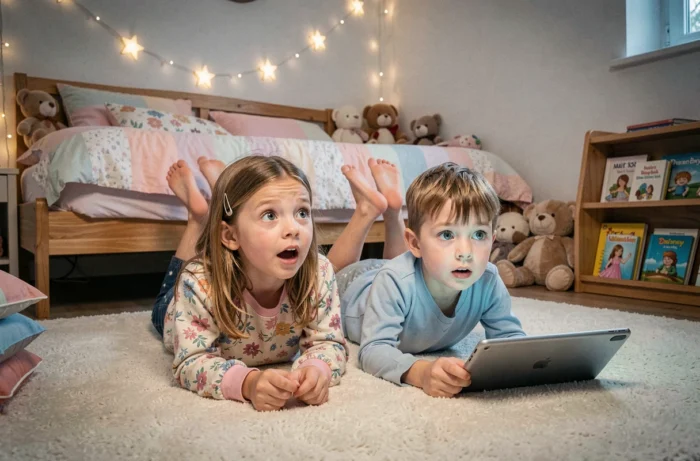
A shared movie generates conversations that a solo viewing does not produce. A child asking “why is the villain doing that?” opens a door that the parent can seize to talk about jealousy, fear, or courage, with concrete words anchored in the story they just watched together.
When to cut and when to let the emotion pass
Pausing at the first sign of concern is not always the right response. A slight narrative stress (the hero in trouble) is part of emotional learning. The limit is reached when the child turns away from the screen, covers their ears, or explicitly asks to stop.
Offering a break rather than imposing one allows the child to decide their threshold. “Do you want to stop, or do you want to see what happens next?” works better than a sudden black screen, which can create more anxiety than the scene itself.
A child’s first Disney movie does not need to be a critical masterpiece. It should match what the child can handle that day, in that context. The great classics can wait a few months or years, and they will be all the more appreciated.