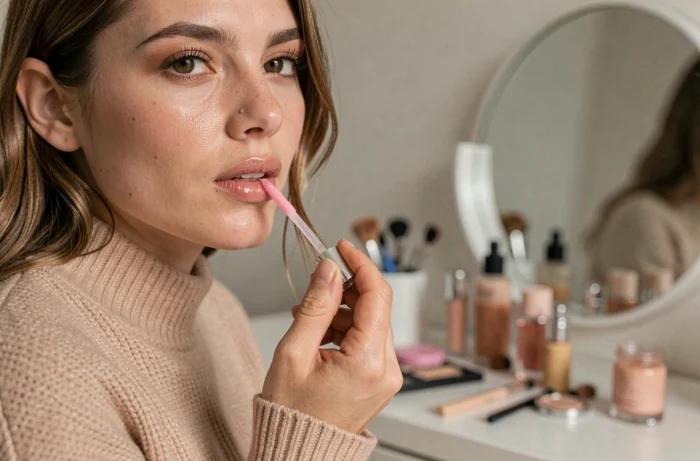
Gloss is one of the oldest and most frequently reformulated makeup products. From the sticky textures of decades past to today’s compositions enriched with active ingredients, this lip product has changed its status. It no longer just leaves a shiny film: recent formulas incorporate moisturizing agents, protective filters, and textures that have little in common with the gloss of twenty years ago.
European Regulation and INCI List: What Regulation 2023/1545 Changes for a Gloss
A gloss is a rinse-free cosmetic product applied to a thin and sensitive area of skin. This characteristic places it under precise regulatory scrutiny, particularly regarding fragrance allergens.
The European Regulation 2023/1545 has expanded the list of fragrance allergens that must be declared individually on the label. For rinse-free products like gloss, any allergenic substance must be included in the ingredient list as soon as it exceeds the threshold of 0.001% in the finished product. New products launched on the market must comply with these rules since July 31, 2026, while products already marketed benefit from a transitional period until July 31, 2028.
For those prone to skin reactions or contact allergies, consulting the INCI list before purchase becomes a relevant reflex. A gloss labeled as “natural” or formulated with significant oils is not necessarily free from allergens that need to be declared, as the regulation also targets substances derived from natural raw materials. The label alone, with its marketing claims, is not sufficient: it is the detailed composition that provides the information.
Understanding why to choose gloss on Touche de Beauté also involves this careful reading of the ingredients, which distinguishes a care product from a purely cosmetic one.

Gloss and Microplastics: A Composition to Check
The issue of microplastics in cosmetics directly concerns glosses. The European restriction on intentionally added synthetic microplastics affects cosmetic products, with varying transition periods depending on the categories.
A gloss often contains synthetic polymers that contribute to the film-forming texture and mirror effect. Some of these substances fall within the scope of ongoing restrictions. Manufacturers are gradually reformulating, but not all glosses on the market are yet compliant with future requirements.
Specifically, checking for terms like “acrylates copolymer” or “polyethylene” in the INCI list helps identify synthetic polymers. Alternatives exist, formulated with plant waxes or natural oils, that maintain shine without resorting to these components.
Texture and Formulation: What Distinguishes a Care Gloss from a Purely Cosmetic Gloss
Current formulas are divided into two main families with differing purposes.
Care-Dominant Gloss
These products incorporate actives like shea butter, hyaluronic acid, or plant oils (jojoba, castor). Their primary goal remains the hydration and protection of the lip skin, with shine being a secondary effect. The texture is generally lighter, less film-forming.
Makeup-Dominant Gloss
Here, the priority is the visual effect: mirror shine, pigmentation, optical plumping effect. Film-forming agents are more concentrated to increase light reflection. Comfort may vary depending on the formulas.
The choice between these two categories depends on the intended daily use. For regular daily application, a care-dominant gloss limits the dryness that can be caused by certain highly pigmented formulas applied for several hours in a row.
- Shea butter and jojoba oil in the INCI list indicate a care orientation with nutritional benefits for the lip skin.
- The mention of “hyaluronic acid” indicates a surface moisturizing effect, useful for lips prone to tightness.
- Terms like “plumping” or “repulping” often correspond to mildly irritating actives (menthol, capsaicin) that temporarily swell the lips through increased blood flow, a mechanism to be aware of before adopting it daily.
Daily Gloss Application: Mistakes That Alter the Result
Most beauty guides detail the application steps. Less common is the analysis of mistakes that reduce wear or alter the finish.
Applying gloss on unexfoliated lips accentuates irregularities instead of masking them. Dead skin cells unevenly capture the product, creating matte and shiny areas. A gentle scrub before application, even a quick one, changes the result.
Another often overlooked point is the quantity. An excess of product causes the infamous sticky effect that remains the main complaint against gloss. A thin layer, concentrated in the center of the lips and then blended towards the edges, is enough to achieve shine without discomfort.
Pairing with a lip liner is not just an aesthetic issue. The liner creates a physical barrier that prevents the gloss from migrating into the perioral fine lines, a phenomenon exacerbated by body heat and the fluid texture of the product.
- Exfoliating the lips once or twice a week prepares the surface for an even gloss application.
- Applying the product in a thin layer from the center outwards limits the sticky effect and prolongs wear.
- Using a nude or matching lip liner prevents product migration beyond the natural lip contour.
Gloss and Beauty Trends: A Product That Transcends Cycles
Gloss reappears in makeup trends cyclically. The phases of popularity for matte lipstick alternate with periods where shine takes over. The current period favors luminous textures and “glass skin” finishes that extend from the face to the lips.
The price positioning of gloss remains accessible compared to high-end lipsticks, making it easier to adopt daily without a heavy financial commitment.
Gloss also works as a layering product: applied over lipstick, it modifies the finish and color without requiring a new product. This versatility partly explains its longevity in makeup bags, beyond fashion trends.
Reading the composition remains the best selection filter, more so than packaging or marketing promises. A well-chosen gloss, suited to one’s skin and use, simultaneously fulfills a care and makeup function, justifying its place in a daily beauty routine.