Galeries Lafayette started as a small haberdashery of just a few dozen square meters opened at the end of the 19th century. Two Alsatian cousins, Théophile Bader and Alphonse Kahn, settled in 1893 at the corner of rue La Fayette and rue de la Chaussée d’Antin in Paris. Their ambition: to sell textile novelties in a neighborhood bustling with commercial activity.
What follows, over a little more than a century, transforms this shop into a monument of consumption visited as much as the Eiffel Tower. Understanding this trajectory is to grasp how a store can become a cultural institution.
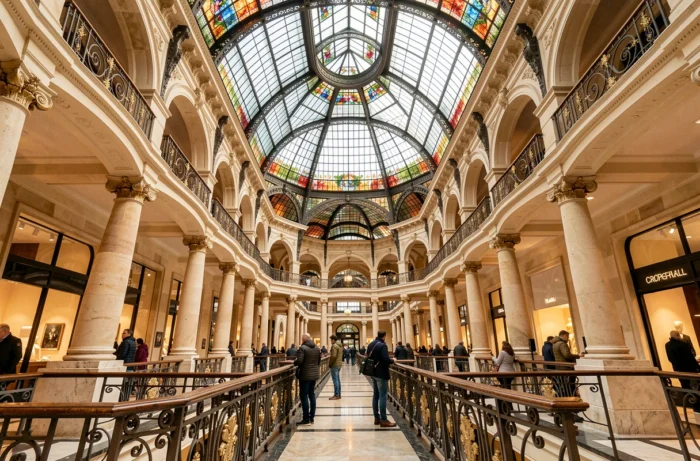
The Art Nouveau dome, the architectural signature of Galeries Lafayette
Have you ever looked up under the dome of Boulevard Haussmann? This glass and steel dome, inaugurated at the beginning of the 20th century, serves a very concrete purpose: to flood the sales floors with natural light at a time when electric lighting remains expensive.
The work along Boulevard Haussmann was entrusted to architect Georges Chedanne, then continued by Ferdinand Chanut. The decorative richness of the whole, with its ornate balustrades and metal structures, makes it an architectural landmark recognized on a Parisian scale.
To trace in detail the history and evolution of Galeries Lafayette, one must measure the role of this architecture. It does not merely decorate commerce; it stages it. The building becomes a free spectacle that attracts passersby inside, a selling point in itself.
Windows and staging: the invention of a commercial language in Paris
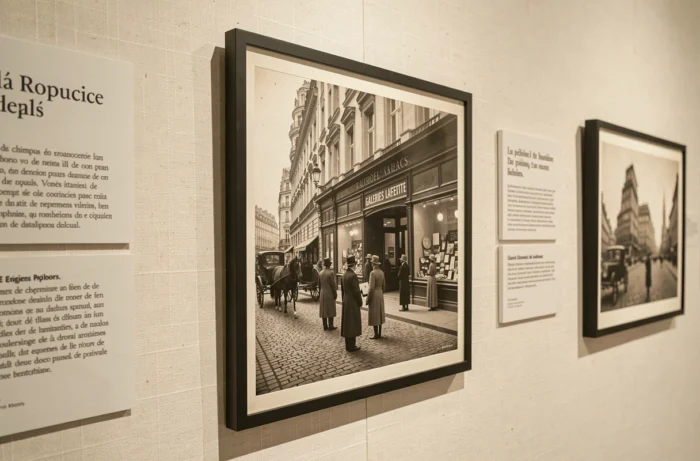
The 1925 International Exhibition of Decorative Arts changed the way objects are presented. Before this date, windows served as simple displays. After, they became vignettes, almost little street theaters.
At Galeries Lafayette, this principle is taken far. The lighting and scenography are designed to capture the passerby even before they cross the threshold.
The effect is measurable: thousands of onlookers stop every day in front of the facades. Window design acquires a status of its own, recognized well beyond the world of commerce.
What windows change in the relationship to fashion
Before department stores, trends were discovered in private salons or through press engravings. Windows make fashion visible on the street, accessible to all eyes, without an entry ticket. It is a form of visual democratization of luxury, long before mass ready-to-wear.
Galeries Lafayette understood very early on that the window is not an ordinary advertising medium. It serves multiple functions at once:
- Attracting attention with a scenography renewed each season, with displays that sometimes rival those of the theater
- Building a distinctive brand image, different from that of Printemps or Bon Marché, by betting on decorative boldness
- Transforming the sidewalk into an extension of the store, erasing the boundary between public space and commercial space
Expansion outside of Paris: how Galeries Lafayette adapts its model in the regions
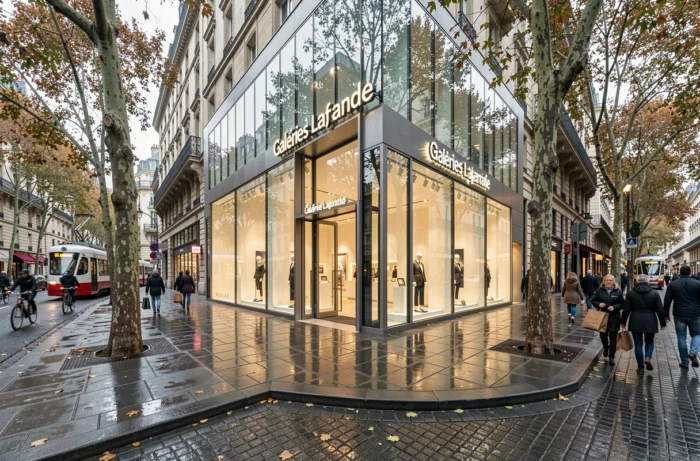
Boulevard Haussmann remains the flagship store. But the brand does not limit itself to that. Transposing a model born in an exceptional building to cities with very different constraints poses a real challenge.
The example of Bordeaux illustrates the approach taken. Rather than demolishing everything, management chose to reactivate existing heritage spaces. Windows masked by reserves have been highlighted, and a VIP lounge has taken place in the former management office, where the original parquet and woodwork remain. The Art Deco references of the Bordeaux building are showcased, not erased.
The renovation is done in stages, without interrupting operations. Two levels reopened after eight months of work, while the other floors remain to be treated. LED lighting replaces the old installations, with a gain in energy efficiency. The customer journey has been redesigned to offer more space.
Testing an adapted format in medium-sized cities
In some medium-sized cities, Galeries Lafayette has experimented with smaller formats, with results that management describes as positive. This feedback shows that the brand can operate outside major metropolitan areas, provided the surface area, offering, and positioning are adjusted to the local customer base.
A space dedicated to young creators at Galeries Lafayette
Beyond ready-to-wear from established brands, Galeries Lafayette has opened a space reserved for emerging designers. The idea is to give commercial visibility to young talents who have not yet accessed traditional distribution channels.
Why this choice? The traditional department store risks becoming an interchangeable distributor. By welcoming emerging creation, the brand repositions itself as a place of discovery, not just consumption. It is a return to the spirit of its origins: the store of novelties, in the truest sense of the term.
This cultural positioning is also expressed through exhibitions and regular events within the flagship Haussmann. The dome serves as a backdrop for artistic installations that sometimes have no direct link to the sale of clothing.
From Alsatian cousins selling fabric on rue La Fayette to a brand hosting contemporary art exhibitions under a century-old dome, the trajectory of Galeries Lafayette mirrors that of modern commerce. Each era has added its layer: spectacular architecture, the window as art, regional expansion, support for creation. The store of 1893 has not simply grown; it has changed its nature with each decade.